
When a Payout Gets Stuck: Confirmations, Fees and the Acceleration Option
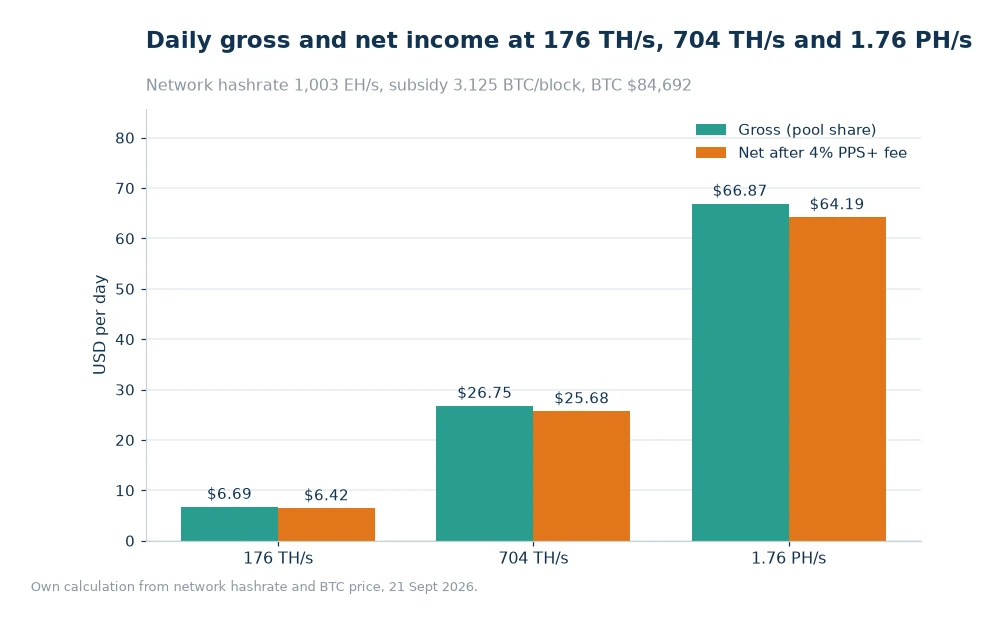
Mined coins arrive with a confirmation count attached, and a transaction that sits unconfirmed can strand a payment just as effectively as a machine going offline. The accelerator exists for that moment. Meanwhile the income side keeps running: at 176 TH/s the pool produces 7.895e-05 BTC a day, $6.69 at $84,692 per BTC and $6.42 after the listed 4% on the block-reward component, and every one of those coins needs a confirmation before it can be spent.

Key takeaways
- 176 TH/s earns 7.895e-05 BTC a day, $6.69 gross and $6.42 net, and each payout needs confirmations before it can be spent.
- A free accelerator submission needs a transaction of 0.5 KB or less with a fee rate of at least 0.0001 BTC/KB.
- Free submissions are handled in arrival order against an hourly quota, so timing matters as much as eligibility.
- Paid acceleration accepts BTC, BCH or LTC, is non-cancellable and carries no refund.
Why a transaction waits
Bitcoin blocks are limited in size, and miners choose which transactions to include. The choice is economic: a transaction paying a higher fee per kilobyte is more attractive than one paying less, so a low fee rate can leave a transfer waiting while higher-paying ones clear ahead of it. During a quiet mempool the wait is minutes. During a busy one it can be hours or days, and the transaction does not expire; it simply sits.
Replacing it is possible, but replacement requires a new transaction with a higher fee, and not every wallet makes that easy. The alternative is to have the original transaction included as it stands, which is what an accelerator arranges. That is a narrow, useful tool rather than a general fix, and the eligibility rules are worth reading before you need them.
What acceleration actually does
The ViaBTC TX Accelerator submits a transaction to the pool with a promise that it will be included in the next block ViaBTC mines. The pool is a large one, so its next block is not a distant event, but the promise is specifically about the pool's own block rather than about the network as a whole. If the mempool is congested, inclusion in that block is what resolves the wait.
Three conditions define the free route. The transaction must be 0.5 KB or smaller, the fee rate must be at least 0.0001 BTC/KB, and the submission must land inside an hourly quota that is allocated first-in, first-served. A transaction that meets the size and fee tests but arrives after the hour's quota is exhausted waits for the next window.
The rules that catch people out
Submission is final. Once a transaction is accepted it cannot be cancelled and the fee, if any, is not refunded. That matters because a transaction that confirms by other means before the accelerated block is mined still consumes the submission. There is no partial credit and no queue position to reclaim.
Two technical limits cause most rejections. Transactions that attempt a double spend are not accepted, which is the right behaviour for a service built on the assumption that one payment settles once. Transactions with unconfirmed inputs are also rejected, and the fix is to accelerate the earlier transaction first, then submit the one that depends on it. A chained payment cannot skip ahead of its parent.
Paid acceleration is available when the free route does not fit, with the fee payable in BTC, BCH or LTC and deducted from the account balance. It is worth pricing before submitting, because a paid acceleration on a small transfer can cost more than the transfer is worth.
What the income side looks like
Acceleration is usually discussed in isolation, as if the coins were unrelated to mining. In practice the two are connected: a miner waiting on a payout confirmation is waiting on the same mechanism. The bands below show the daily output that a payout represents at three hashrate levels.
| Hashrate | BTC per day | Gross per day | Net per day | Equivalent to |
|---|---|---|---|---|
| 176 TH/s | 0.00007895 | $6.69 | $6.42 | one day at 176 TH/s |
| 704 TH/s | 0.00031585 | $26.75 | $25.68 | four days at 176 TH/s |
| 1.76 PH/s | 0.00078955 | $66.87 | $64.19 | ten days at 176 TH/s |
That framing gives the accelerator a threshold. If a stuck transfer is worth $6.42, paying a fee that approaches that amount to accelerate it is a poor trade; waiting is cheaper. If the transfer is a settlement to a supplier with a deadline attached, the same fee is trivial against the cost of missing it. The tool has no opinion about which case you are in.
Worked example
Take the smallest band, build the daily figure, then scale it to see when acceleration is worth paying for.
- Network share: 176 divided by 1,003,000,000 TH/s equals 1.755e-07.
- Daily coins: 1.755e-07 multiplied by 450 BTC equals 7.895e-05 BTC.
- Gross value: 7.895e-05 multiplied by $84,692 equals $6.69.
- Listed fee: 4% of $6.69 is $0.27, leaving $6.42 net.
- Four times the hash at 704 TH/s: 0.00031585 BTC, $26.75 gross, $25.68 net.
- Ten times the hash at 1.76 PH/s: 0.00078955 BTC, $66.87 gross, $2.68 of listed fee, $64.19 net.
- Thirty days at 1.76 PH/s: $2,006.10 gross and $1,925.70 net, which is the scale at which a stuck settlement matters.
- Fee test: a 0.4 KB transaction paying 0.0001 BTC/KB clears the free threshold, since 0.4 multiplied by 0.0001 is 0.00004 BTC, a few dollars at this price.
A short checklist before submitting
Confirm the transaction is still unconfirmed and that you hold the wallet it came from. Check its size and fee rate against the free thresholds rather than guessing from the amount. Check whether any input is itself unconfirmed; if it is, deal with the parent first. Then submit early in an hour rather than late, because the quota is first-in, first-served.
Do not submit the same transaction twice in the hope of improving the position. Duplicate submissions do not create a second queue slot, and the submission is final in any case. If the transaction confirms through the ordinary route while a submission is pending, accept that the fee did its job in a different way.
The wallet side of a fast confirmation
Acceleration solves one link in the chain. The rest is bookkeeping: a confirmed balance has to be visible, spendable and convertible without moving between platforms. A multi-currency wallet inside the same account as the mining balance keeps the confirmed coins where the next action can reach them, which shortens the path between a confirmation and a payment.
For miners paid in several coins, that matters more than it sounds. A DOGE balance from merged mining and a BTC balance from the primary chain confirm on different schedules, and tracking both across separate wallets is how a payment gets missed. One account with one history removes the reconciliation step.
Frequently asked questions
What makes a transaction eligible for free acceleration?
A size of 0.5 KB or less and a fee rate of at least 0.0001 BTC/KB, submitted while the hourly free quota still has room, since requests are handled in arrival order.
Can I cancel an acceleration after submitting?
No. Submissions are non-cancellable and the fee is not refunded, even if the transaction confirms through the ordinary mempool route before the accelerated block.
Why was a transaction with unconfirmed inputs rejected?
Because the accelerator will not build on an unconfirmed parent. Accelerate the earlier transaction first and resubmit the dependent one once its input is confirmed.
Read the rules before the queue
Stuck transactions are a timing problem, not a mining problem, and the fix takes minutes when the eligibility is already understood. Check size, fee rate and input status first, submit early in the hour, and price the paid route against the value of the payment rather than against the value of the coins behind it.
Sources: the accelerator's published eligibility and submission rules[1], with chain inputs read 21 Sept 2026: network hashrate about 1,003 EH/s, difficulty 132.76 T, 3.125 BTC per block over 144 blocks a day and BTC at $84,692. Figures read 21 Sept 2026, published 22 Oct 2026.